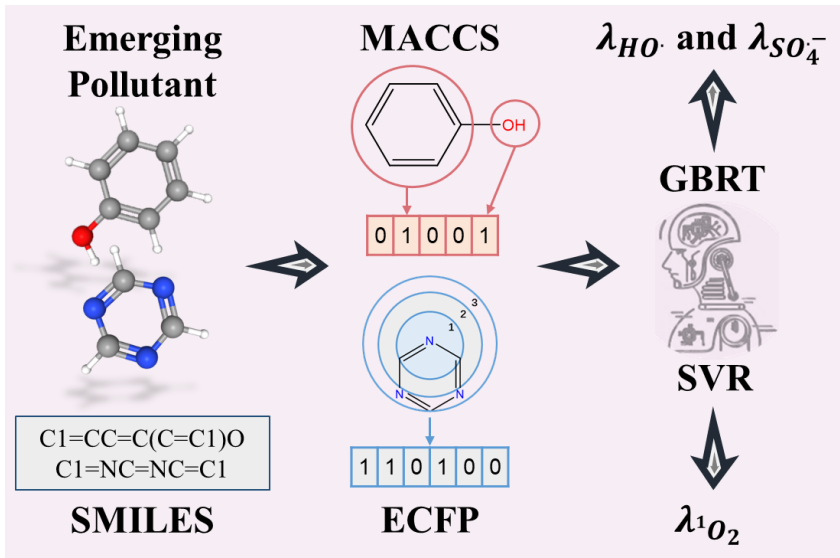
Developing reliable machine learning (ML) models integrating molecular descriptors to predict reactive oxygen species (ROS) contribution rates holds crucial implications for rationally designing tailored advanced oxidation processes (AOPs) to achieve precise oxidation of emerging pollutants.
This web developed two Gradient Boosted Regression Tree (GBRT) models and one Support Vector Regression (SVR) model, incorporating molecular fingerprints to accurately, efficiently, and cost-effectively predict the contribution rates of three key oxidative ROS in the peroxymonosulfate (PMS) systems:HO•, SO4•−, and 1O2. The website helps regulate the proportion of ROS in the AOPs-PMS system, thereby achieving precise and efficient degradation of pollutants.
Workflow
This web utilizes GBRT and SVR models to predict the relative contribution percentages of HO•, SO4•−, and 1O2 in PMS-based reaction systems for pollutant degradation. In addition, molecular structure visualization and judgment of applicability domain are also included. Users only need to input the SMILES of the target pollutant and the pH value of the solution.
Molecular structure: